I Made a Need for Speed Style Game With Claude Opus 5.5: Every Prompt
Kartit Nitro, a browser racer built with Claude Opus 5.5: the 3D car cost $0 on a free Kaggle GPU, and $0.64 of AI music ships in the game.
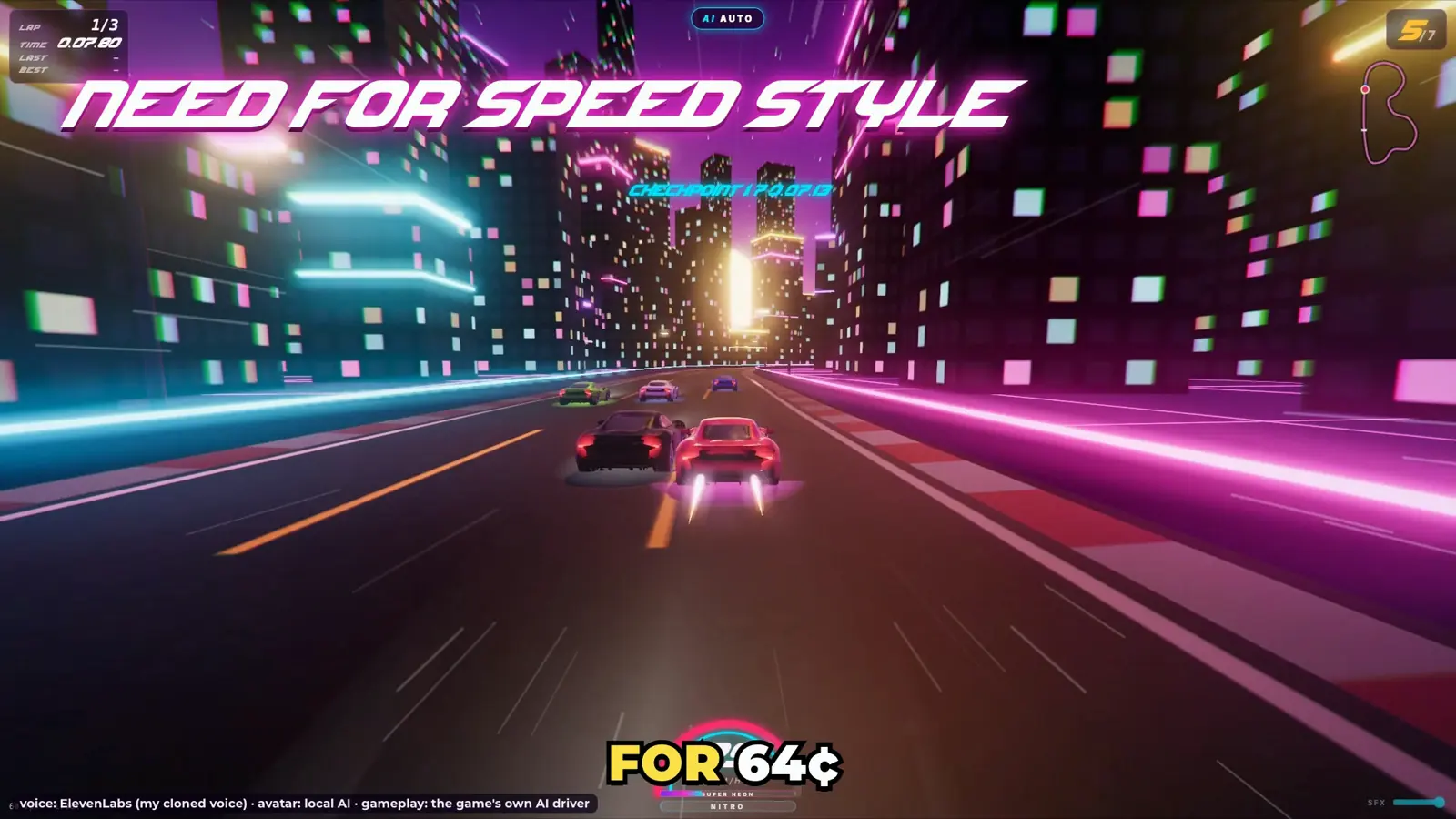
Kartit Nitro is a racing game in the style of Need for Speed that I built with Claude Opus 5.5, and it runs in your browser. The 3D car cost $0 on a free Kaggle GPU, and the AI music and sound that ship in the game cost $0.64 (audited 25 September 2026). This post is the written version of the tutorial video: every prompt, every command, how long each step took and what it cost, so you can build your own. At the end, you can race the game and try to beat the AI driver’s lap.
Key facts (quick answer)
| Fact | Value |
|---|---|
| Game | Kartit Nitro (formerly NEON RUN), three.js + cannon-es, plays in the browser |
| Built with | Claude Opus 5.5 (code), Codex image gen (car picture), TRELLIS (3D), Blender (wheels), Lyria 3 Pro (music, SFX), Gemini 3.8 Flash TTS (announcer) |
| 3D car | TRELLIS on a free Kaggle Tesla T4: 39.4 s, 12,444 faces, $0 |
| Wheel rig | Headless Blender script: 4 of 4 wheels, 42 s with a test render |
| AI spend that ships | $0.64 (8 Lyria calls at $0.08) |
| All Lyria calls | $1.04 (13 calls, 5 discarded) |
| Not counted | Claude and ChatGPT subscriptions, the Mac, the unlogged TTS cost |
| AI driver’s best lap | 33.3 s |
TL;DR
- Step 1: one Codex image prompt drew the car. The trick is the last line: tell it the image becomes a 3D model.
- Step 2: TRELLIS turned it into a textured 3D car in 39.4 s on a free Kaggle T4, the best of 4 free models.
- Step 3: a Blender script cut off all 4 wheels in about 4 s, so they spin and steer.
- Step 4: one casual sentence to Claude Opus 5.5 became the game; 4 play-test complaints became 4 fixes.
- Step 5: Lyria 3 Pro made the music and SFX: 8 calls ship, $0.64.
- Step 6: static files, free hosting, a leaderboard. Race it below.
What do you need to build it?
Five accounts, and only one of them charges per use:
- A free Kaggle account (30 GPU hours a week on a Tesla T4).
- ChatGPT, for Codex image generation.
- Blender (free, runs headless).
- Claude, for Opus 5.5 in Claude Code.
- A Gemini API key, for Lyria music and TTS (the only pay-per-call step).
Step 1: how do you prompt an image that becomes a good 3D model?
Ask for one object on pure white, all wheels visible, and say what the image is for. My exact Codex prompt:
A single small red sports car, stylized clean 3D render, three-quarter front view from slightly above, the whole car fully visible and centered with space around it, all four wheels clearly visible with black tires and silver rims, pure white background, soft even studio lighting, no ground shadow, no reflections of other objects, no text, no logo, no license plate text. This image will be converted into a 3D model, so keep the shape clear and the edges clean.The last sentence matters most: it pushes the image toward clean silhouettes, which image-to-3D models reconstruct far better.
Step 2: how do you turn the picture into 3D for free?
Run TRELLIS on a free Kaggle T4. localfit wraps it in one command (experimental):
$ localfit 3d generate car.png --model trellis --backend kaggle --quality standard --out car.glb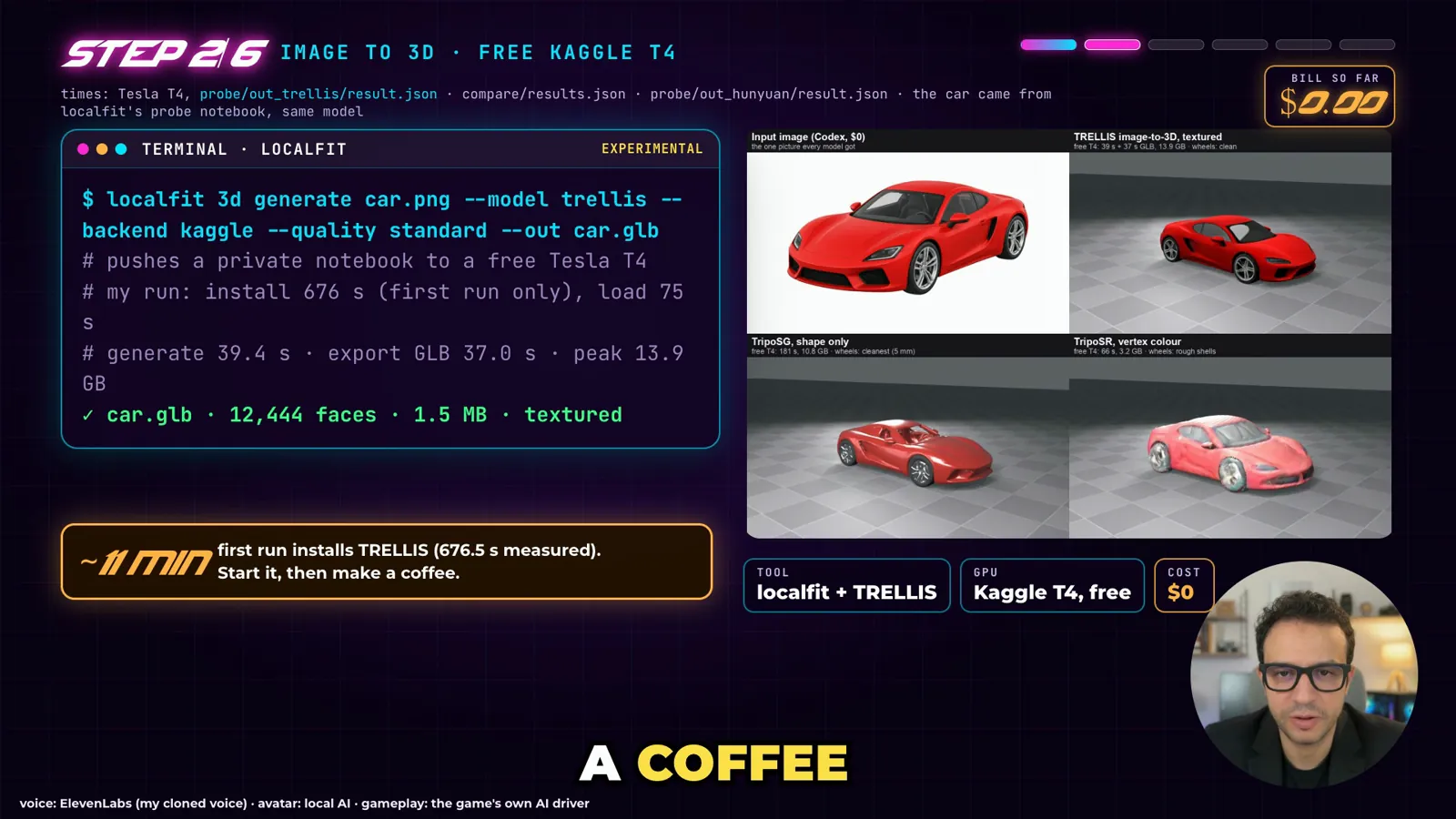
| Model (same image, same free T4) | Result |
|---|---|
| TRELLIS | textured mesh, 12,444 faces, 39.4 s to generate |
| TripoSR | 93,368 faces, blurry vertex colours |
| TripoSG | 1,696,424 faces, no colour |
| Hunyuan3D-2mini | textured, but its licence excludes the EU |
Warning: the first run spends 676.5 s installing TRELLIS. Start it, then make a coffee. Every timing is in the deep dive, Free AI Image-to-3D on a Kaggle T4.
Step 3: how do the wheels spin on one AI mesh?
A Blender script finds the four wheels from the shape alone and cuts them off the body:
$ blender -b --factory-startup --python car_anim.py -- car.glb out/The cut takes about 4 s; with a test render the whole script ran in 42 s. Now the wheels can spin and steer.
Step 4: what did I actually ask Claude Opus 5.5?
My first message to Claude Opus 5.5, verbatim, typos kept: “and also make the car game need for speed like super fast fire stuff”. Then play-test complaints, each one a fix: “car game lack physics”, “cannon js?”, “we need glowing car lights”, “where is speeding game and nitro”.
Claude turned that one line into a brief: a three.js track, nitro flames, drifting on the handbrake and a chase camera with speed-dependent lag. The result has cannon-es physics, four cameras, nitro, a SUPER NEON ghost mode and an AI driver. That AI drives every gameplay shot in the video.
This was not one shot. The loop was: play it, complain in plain words, let Claude fix it.
Step 5: how do you make game music and sound with Lyria 3 Pro?
Say instrumental only, give a tempo, and ask for no intro and no ending so it loops:
Instrumental only, no vocals. Driving synthwave / outrun night-drive racing track: pulsing 16th-note analog bass, gated reverb drums, bright saw-lead arpeggios, neon 80s retro-futuristic energy, 124 BPM, minor key, relentless forward momentum. Constant full-energy groove from the first second to the last with no intro, no breakdown and no ending, so it loops seamlessly. About 90 seconds.For sound effects, ask for several variations separated by silence, then cut them apart:
Sound effects library recording for a video game. No music, no melody, no rhythm, no vocals, no background ambience. Six isolated variations of the same sound effect, each separated by three seconds of total silence: a bright electronic synthwave lap-complete jingle, a quick rising synth arpeggio chime, about one second each.8 of 13 Lyria calls made it into the game: $0.64. Five were discarded takes, and two of those came back empty. The announcer is Gemini 3.8 Flash TTS with the Fenrir voice: 14 short lines like “three, two, one, go”. Its cost was not logged.
Step 6: how do you ship it?
The game is plain static files, so it is a free web page with an online leaderboard. Bonus: register localfit as an MCP server and Claude can run step 2 for you:
$ claude mcp add llmrun-3d -- python3 -m localfit.mcp_3dPlay Kartit Nitro
The AI driver’s best lap in the video is 33.3 s. Beat it and your name goes on the leaderboard. Controls, physics, the garage colour shader and the audio are explained in the full build write-up, which also has the game embedded.
What did it really cost?
| Step | Cost | Source |
|---|---|---|
| Car image (Codex) | $0 extra (ChatGPT plan) | gen_car.js, car.log |
| 3D car (TRELLIS, Kaggle T4) | $0 | probe/out_trellis/result.json |
| Wheel rig (Blender) | $0 | car_anim.py run |
| Game code (Claude Opus 5.5) | $0 extra (Claude plan) | Claude Code session |
| Music + SFX that ship (8 Lyria calls) | $0.64 | racer/audio/lyria_log.json |
| Discarded Lyria takes (5 calls) | $0.40 | racer/audio/lyria_log.json |
| Announcer (Gemini TTS) | not logged | tts_log.json |
Caveats
- $0.64 is what ships, not everything spent. All Lyria calls came to $1.04, and the TTS cost was not logged.
- Subscriptions are not counted. Claude and ChatGPT plans are flat fees you may already pay.
- localfit 3D is experimental and not in a release yet.
- The first Kaggle run is slow: 676.5 s of installs before the first model runs.
My take
The headline is the price, but the lesson is the loop. The 3D car took 39 seconds of GPU on a free notebook. The game got good because I played it and complained in plain words, and Opus 5.5 turned each complaint into a fix. If you have a weekend, you can build this.
Sources
- TRELLIS, Microsoft: https://github.com/microsoft/TRELLIS
- Kaggle notebooks with GPU: https://www.kaggle.com/docs/notebooks
- three.js: https://threejs.org and cannon-es: https://github.com/pmndrs/cannon-es
- Lyria 3 Pro and Gemini TTS, Google: https://ai.google.dev/gemini-api/docs
- Costs: my own logs, audited 25 September 2026 (lyria_log.json at the published $0.08 per call). Timings: my own runs of 23 and 24 September 2026. None are vendor-reported.
Independent tutorial by Anass Kartit, kartit.net. Game built with Claude Opus 5.5. Not affiliated with Anthropic, OpenAI, Microsoft, Kaggle, Google or Electronic Arts; Need for Speed is a trademark of Electronic Arts. Video made with LocalAIAvatarStudio.
Newsletter
Get the next post and game in your inbox
One email when I publish something new: measured write-ups on AI, local models and cloud, plus games like NEON RUN.