Kimi K3.1 Pro vs Opus 5.5: Six AI IKEA 3D Guides Tested
Six builds, five models, one 24-page IKEA manual. Compare Kimi, Opus, GPT and Gemini with live demos, 23-step checks, measured times and cost caveats.
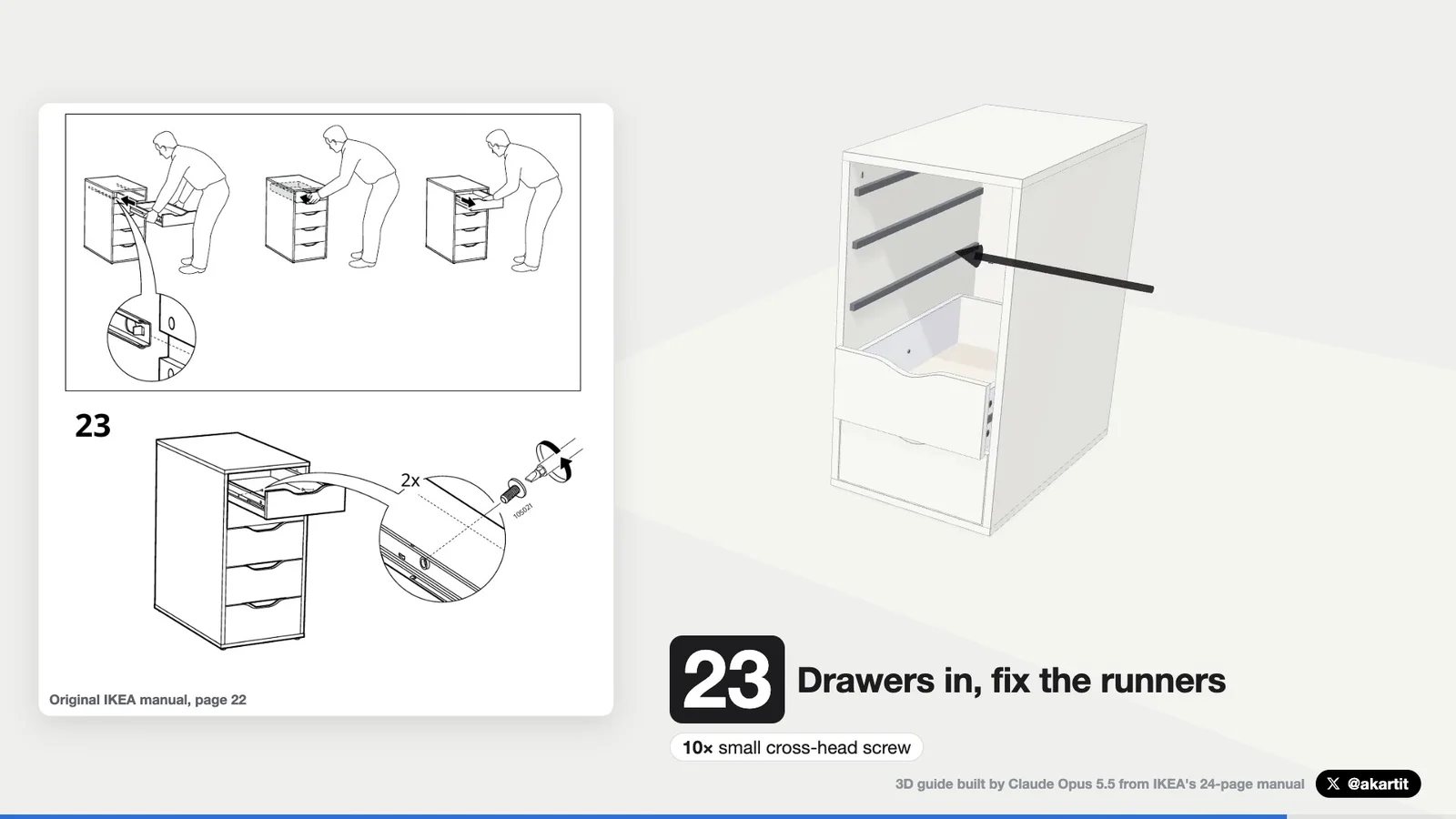
Kimi K3.1 Pro, Claude Opus 5.5, GPT-6.1 Sol, GPT-6 Astra and Gemini 4 Argon attempted the same 24-page IKEA ALEX manual-to-3D task on 25 October 2026. Across six builds and 23 numbered steps, Sol through Codex and Opus tied at 46/46 on the manual rubric. Kimi delivered a working hosted interface but scored 12/46 for assembly correctness. This expanded review preserves the original Opus article’s URL and adds the other results, live demos, effort settings, recorded durations and cost qualifications.
Key facts (quick answer)
| Fact | Result |
|---|---|
| Input | 24 PNG pages of IKEA ALEX manual AA-2242840-5 |
| Builds | 6 builds from 5 model names; GPT-6.1 Sol ran twice |
| Required output | An interactive, animated 3D assembly guide |
| Manual check | 23 steps scored 0, 1 or 2; maximum 46 |
| Feature check | 11 interaction and presentation checks |
| Highest manual scores | GPT-6.1 Sol through Codex and Claude Opus 5.5: 46/46 |
| Fastest measured final result | Sol through Codex: 19 min 18 s |
| Kimi timing | Unmeasured; no reliable prompt-start timestamp |
| Dimensions | Estimates, not manufacturing drawings |
| Public demo | One dropdown switches between all six results |
TL;DR
- 2 builds scored 46/46 for the tested manual steps: Sol through Codex and Opus.
- Kimi scored 10.5/11 for features but 12/46 for correctness. Working controls do not prove that the assembly is right.
- Astra scored 45/46, losing a point for a transposed desktop-screw identifier.
- The second Sol run scored 44/46 because step 5 keeps its required panels and bolts hidden.
- Argon scored 43/46, but its default first-person camera obscures several operations.
- $2.5562 is Argon’s latest recorded list-price usage, covered by free credits. Subscription API equivalents are estimates, not actual charges.
Where can you try every model?
Use the Model dropdown in the live comparison. The original URL now opens the selector instead of presenting Opus as the only result.
| Build | Direct demo selection |
|---|---|
| Claude Opus 5.5 | Open Opus |
| Kimi K3.1 Pro | Open Kimi |
| GPT-6.1 Sol, Codex run | Open Sol through Codex |
| GPT-6 Astra | Open Astra |
| GPT-6.1 Sol, second run | Open the second Sol run |
| Gemini 4 Argon | Open Argon |
Kimi remains hosted on its original Kimi page. The other five results are served on kartit.net. The selector provides an Open demo link if an embedded result is unavailable.
How do the six builds compare?
The table keeps manual correctness, interface features and visual judging separate because they measure different things.
| Build | Effort | Manual /46 | Features /11 | Blind visual /40 | Recorded final time |
|---|---|---|---|---|---|
| GPT-6.1 Sol, Codex run | High | 46 | 11 | 32 | 19:18 |
| Claude Opus 5.5 | High | 46 | 11 | 26 | 40:55 |
| GPT-6 Astra | High | 45 | 11 | 27 | 25:02 |
| GPT-6.1 Sol, second run | High | 44 | 10.5 | 33 | 24:44 |
| Gemini 4 Argon | Medium | 43 | 10 | 9 | 31:03 |
| Kimi K3.1 Pro | High | 12 | 10.5 | 18 | Unmeasured |
The ordering uses manual correctness, then features, then the per-build blind visual total. Sol through Codex and Opus therefore tie on the first two checks; the visual tie-break places Sol first. A separate six-way visual comparison preferred Opus. These are different judging passes, not interchangeable measurements.
The runs shared a starting task, not identical controlled conditions. Tools, access plans and follow-up prompts differed. Those limitations matter when interpreting the table.
What did Kimi K3.1 Pro get wrong?
Kimi’s biggest failure is the gap between a working interface and the assembly actions it depicts.
| Manual requirement | Reviewed Kimi result |
|---|---|
| Page 5: side panels lying flat, hardware entering the panels | Upright panels and floating bolts/dowels |
| Page 8, step 6: fit the top and bottom panels | A thin back sheet slides in instead |
| Drawer backs installed after the bottoms | Some backs arrive with the sides; narrow rear rails are invented |
| 4 hammer-in pins per drawer | 2 per drawer in the reviewed scenes |
| 4 cams across the 2 shallow drawers | 4 per shallow drawer, doubling the intended quantity |
Kimi does show the final arrangement of two shallow drawers above three deep drawers. Its controls and framing are useful. The conclusion is about this build: it is an interactive prototype that needs substantial source correction, not evidence that every future Kimi run will fail.
What worked in Opus and Sol through Codex?
Both builds matched every tested numbered instruction under the manual rubric, including the cabinet orientation, repeated drawer construction and final drawer arrangement.
Opus makes the movement particularly easy to connect to the source page. Sol through Codex matches the printed hardware totals in its scene instances and completed faster in the recorded run. Both still have presentation limitations: tiny hardware in wide shots, low contrast between white parts, and repeated actions that need clear counts.
Sol’s own timed run could not perform the browser test because of an approval gate. Later external comparison checks passed. Opus received presentation and demo changes after the timed run, and the available score describes the served version. A 46/46 rubric score is not a claim that every geometric detail has been physically validated.
What failed in Astra, the second Sol run and Argon?
Each has a different failure that a final screenshot could miss.
- Astra: the manual prints desktop screw 110907; the guide repeats 101907 in its data and interface. The quantity is four, but the identifier is wrong.
- Sol, second run: step 5 says to fit twelve bolts into the top and bottom panels, while both panels and the bolts stay hidden. A toolbar also overlaps the lower model in several steps.
- Argon: the default first-person view hides important operations. The manual check inspected it zoomed out. Other issues include back-panel dowels on the wrong edges, deep drawers appearing too early, and a missing tabletop turnover.
These examples explain why checking JSON, checking buttons and checking rendered assembly behavior are separate tasks.
What did the builds cost, and how long did they take?
Actual payment basis is more reliable here than a single hypothetical dollar ranking.
| Build | Actual payment basis | Duration qualification |
|---|---|---|
| Opus 5.5 | Claude Max subscription; no extra API payment for this run | First working milestone 28:44; final recorded completion 40:55 |
| Sol, Codex run | ChatGPT subscription; no extra API payment | 19:18 in the timing record |
| Astra | ChatGPT subscription; no extra API payment | 25:02 |
| Sol, second run | ChatGPT subscription; no extra API payment | 24:44 |
| Argon | $2.5562 at the latest recorded list-price usage calculation, covered by free credits | 31:03; latest window includes 51 calls |
| Kimi | Free web tier | Start time and token usage not reliably measured |
Subscriptions are not free just because a run has no incremental API payment. Earlier Argon accounting used a smaller window and showed $2.53; this article uses the later $2.5562 record. API-equivalent calculations for subscription runs depend on pricing and cache assumptions. They are not invoices or current vendor quotes. Kimi’s recording duration does not establish its build duration.
“High” and “Medium” are the settings in each tool. They do not represent a standardized amount of computation across vendors.
How was the review checked?
Each of the 23 steps was compared with the manual at multiple points in its animation and scored 0 for wrong, 1 for partial, or 2 for matching the tested instruction. The separate eleven-item checklist covered playback, scrubbing, exploded view, part inspection, orbit/zoom, manual comparison, framing, flips, drawer insertion and console errors.
The blind visual judge was Gemini 4 Argon, also one of the contestants. It ranked its own build lowest, but that does not turn a single judging pass into an independent repeated benchmark. Astra and the second Sol run were judged in a later session. Short recorded windows also caused the judge to miss drawer movements that had already happened. Manual checks corrected several judge claims about Opus’s cam-lock and foot locations.
Use the original manual as the primary source, inspect the actual animation, and treat a visual judge as additional evidence.
What did each AI get?
Every AI received the same 24 manual pages and the same short task: read the manual, then turn it into an interactive, animated 3D guide someone can follow step by step. The scores above show how close each one came to the real manual.
What changed since the original Opus article?
The original article documented Opus’s first working result at 28 min 44 s, rounded to 29 minutes. This update adds the final timing and the five other builds without changing the article URL.
The hosted Opus page initially failed because a global Git ignore rule excluded its vendored Three.js runtime from deployment. The runtime now ships. The public demo also corrects the Allen key’s opposing bends and closed hexagonal ends, plus the Phillips screwdriver tip. These are labeled post-review public-demo fixes. They are not silently added to the original timed-run scores. The other public builds retain the reviewed behavior, including their documented mistakes.
My take
The strongest result is not simply a cabinet that looks finished. It is a guide whose parts, movements and identifiers can be traced back to the manual. This experiment makes a useful distinction visible: a polished interface can pass functional checks while teaching the wrong assembly. Ask AI to show its work against the source, then play every step.
Sources and limitations
- Original IKEA ALEX manual, AA-2242840-5, compared on 25 October 2026.
- All six interactive results, with model-specific links and post-review update notes, checked on 25 October 2026.
- Original Kimi-hosted result, checked on 25 October 2026.
- Scores and durations above are measurements from this experiment’s review and run records, not vendor benchmark claims. No physical drawer unit was assembled for validation. Furniture dimensions remain estimates.
Independent review by Anass Kartit. Not affiliated with IKEA or the model vendors. Demo assembly instructions should be checked against the original manual.
Newsletter
Get the next post and game in your inbox
One email when I publish something new: measured write-ups on AI, local models and cloud, plus games like NEON RUN.